Similar to "Mississippi Burning", this film is a history description about prejudice against the 'blacks' in africa. The only big difference is it involves the government and the whole of South Africa. This movie showed how the government treat the Africans by forcefully chasing them away and running their house down, banned Steven Biko, shooting at the children mob, as well as how they use baloney reasons to cover their murder in jail. This actually make me realize some things that is happening around us.
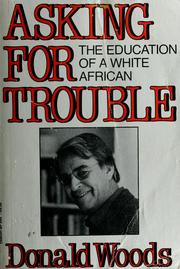
At first impression, I thought the movie would revolve around Steve Biko because at the start of the movie, it mentioned the film was based on the book 'Biko' (picture above) and 'Asking For Trouble' (picture below). But as the movie goes on, Biko died and towards the end it was about how Donald Woods struggle his way to publish his book containing the truth and evil deeds of the South African security force led by the Minister of Police himself, Jimmy Kruger. I don't know why but I got the feeling he's the bad guy during the conversation where Jimmy greeted and invited Donald to the house. Maybe from these lines after Donald Woods commented on not having a police around, "Perhaps not in sight, but if you weren't expected". Or from how he interpose how their white ancestors burgeon the country with the help of slavery from the Africans, or how he described Biko.
At first impression, I thought the movie would revolve around Steve Biko because at the start of the movie, it mentioned the film was based on the book 'Biko' (picture above) and 'Asking For Trouble' (picture below). But as the movie goes on, Biko died and towards the end it was about how Donald Woods struggle his way to publish his book containing the truth and evil deeds of the South African security force led by the Minister of Police himself, Jimmy Kruger. I don't know why but I got the feeling he's the bad guy during the conversation where Jimmy greeted and invited Donald to the house. Maybe from these lines after Donald Woods commented on not having a police around, "Perhaps not in sight, but if you weren't expected". Or from how he interpose how their white ancestors burgeon the country with the help of slavery from the Africans, or how he described Biko.
The most inspiring part of the movie was that Biko, without the certain education, could perform a charismatic speech and debate in court. For example, when the lawyer judged Biko for his 'naked terrorism' to have a confrontation including violence in his paper. Biko responded "You and I are having a confrontation but I don't see any violence" and when the judge asked "Why do you call yourselves black? You look more brown than black". To that, Biko replied "Why do you call yourselves white? You look more pink than white". The judge understands the hidden message in between by acknowledging it with a slight smile and saying "Precisely". It makes me wonder whether it is the actual words in history. As I went through youtube, I saw some videos of Steve Biko's speech and interviews so I guess it's documented straight from recordings of before. I also admire the courage Donald Woods took to help the people after being inspired by Biko and his death. Because personally, I know currently I can't do such thing no matter in any aspects. I also think it was funny that the disguise worked.
From this video, we could see how they segregated and differentiated the 'whites' and the 'blacks' during the APARTHEID. It is an obvious discrimination countrywide that limits the resources of an African. It is no wonder many others have to stand up and speak for their rights. {Just to get banned} I would always think of why would they need to segregate or label people who are different. I do agree we have to know others before judging them with many other sources promoting the learning of the other culture improves racism and prejudice. Prejudice and whatnot always happens with fear first.
For example, in the olden days the Japans called the 'whites' a ghost because they are fair-skinned with bright colored hair and eyes and they drank 'blood'. Obviously this is because previously, the Japanese were conservative and did not know there are other kinds of people and that the 'blood' is actually a drink called red wine. It's the same with Donald Woods where Ramphele criticized his first article on Biko saying he do not understand him. Then slowly, Donald became friends with Biko after few get-a-long meetings and trips to the 'black' society. This could also be seen by the workers in Donald's company who at first troubled by the idea of hiring the Africans. Yet, when one of them got sent to jail all of them came out to send him off and Ken, the photographer, took a picture of the police officer as an act of despise.
"Do you know what we call opinion in the absence of evidence? We call it prejudice." ― Michael Crichton, State of Fear
Thanks to a banned journalist there is no more fear for the government in South Africa. Prejudice is not a problem if the individual is willing to learn and change the facts.
"The most potent weapon of the oppressor is the mind of the oppressed."
Steven Biko
South African's anthem with 3 languages.....